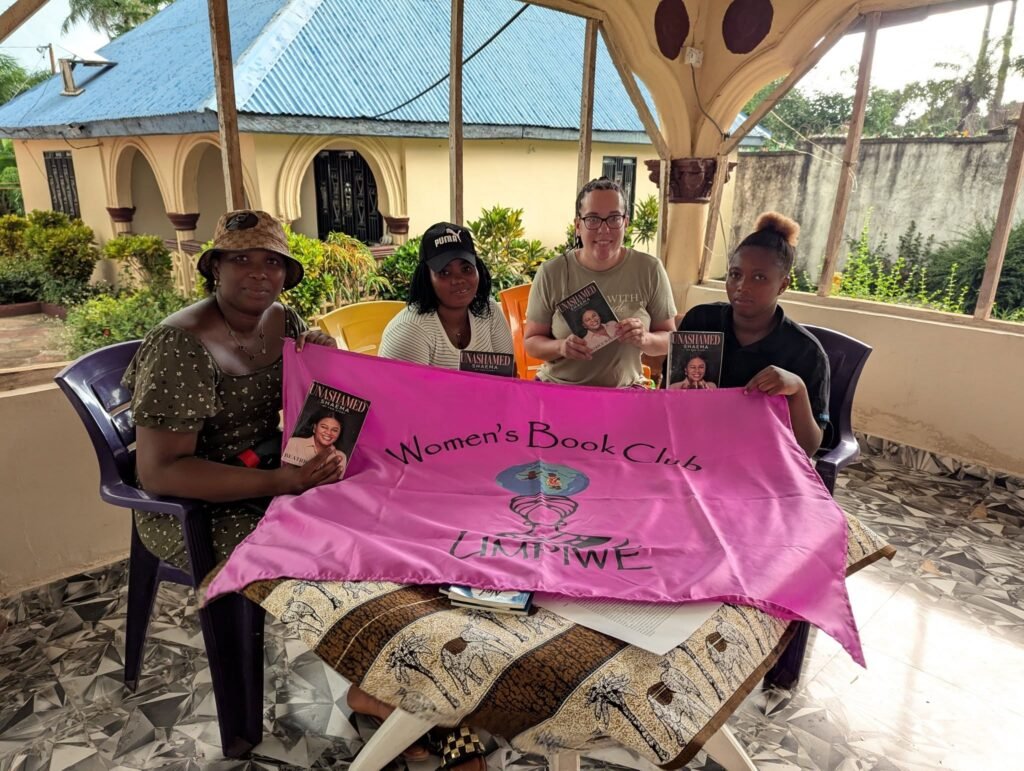
This week, one of the groups in our UMPIWE Women’s Book Club met to discuss Unashamed Shaema: My FGM Story, a book by Beatrice Winning, an author from Makeni, Sierra Leone.
In this powerful and moving account, she shares her personal experience of female genital mutilation (FGM), which she underwent at the age of just 6 years old.
 In Sierra Leone, FGM remains widespread, despite the efforts of numerous organisations raising awareness about its physical and psychological consequences. The practice is traditionally associated with initiation into the Bondo, a female secret society, and symbolises the transition from childhood to adulthood.
FGM is also surrounded by numerous myths and beliefs. One example is the idea that women who retain their clitoris are more likely to have multiple sexual partners or have greater difficulty controlling their sexual desires. Such beliefs contribute to perpetuating a practice that can have serious consequences for the health and well-being of women and girls.
 But things are changing. More and more women are speaking out and expressing their determination to protect their daughters from the experience they themselves endured. At the same time, initiatives are emerging to preserve the cultural teachings and rites of passage associated with the Bondo society while abandoning FGM.
 Yet, in Sierra Leone, FGM is still not generally prohibited by a specific national law, including when it is performed on children. This highlights the importance of continuing efforts in awareness-raising, community dialogue and the protection of girls.
 Reading, sharing experiences and questioning social norms: this is also how change begins.
Through its Women’s Book Club, UMPIWE aims to provide young women with a space for reflection and dialogue on women’s rights, gender equality and the social norms that shape their lives.
Because every girl deserves to grow up safe, protected and empowered to decide her own future.